

Economy Light vs Standard fares can look deceptively similar on the same flight. You have found the right itinerary, but the booking screen offers three economy prices. Light looks attractive; Standard adds a bag; Flex costs more again. The useful question is not which label sounds best. It is which exact ticket covers the trip you are taking at the lowest acceptable total cost.
Fare names are not standardized across airlines. For example, KLM's fare guide describes Basic, Light, Standard and Flex, while Norwegian's guide covers LowFare, LowFare+ and Flex. Compare the benefits shown at checkout, not the words on the fare button.
Economy Light vs Standard: what actually changes?
The table is a comparison checklist, not a promise that every airline offers the listed benefit. Open the fare conditions for both outbound and return flights and fill in the actual rules.
| Feature to compare | Light or basic fare: check | Standard or middle fare: check | Flex or higher fare: check |
|---|---|---|---|
| Cabin baggage | Size, number of pieces and any overhead-bin charge | Whether a larger cabin bag is included | Whether the allowance differs from Standard |
| Checked baggage | Price of the bag you will actually take | Number, weight and route exceptions | Whether the extra allowance is useful to you |
| Seat choice | Cost of your preferred seat or family seating conditions | Which seats are included and when selection opens | Whether your desired seat is included |
| Changes | Change permission, fee and any fare difference | The same terms for your exact route | Whether fees are waived but fare difference still applies |
| Refund | Cash, credit, taxes only or no refund | The precise cancellation deadline | Refund method and deadline |
| Airport and schedule | Confirm the same flight is being compared | Confirm the same flight is being compared | Confirm the same flight is being compared |
An Economy Light vs Standard comparison starts with these concrete inclusions. Do not assume “Flex” means every change is free. The airline may still charge the difference between old and new fares. Nor should you assume “Standard” always includes a checked bag: route and carrier rules can change the allowance.
Start with the bag you will really bring
Many apparent savings vanish when you add baggage. Norwegian's published ticket types distinguish LowFare, LowFare+ and Flex by included bags and other benefits. KLM likewise says that Economy fare options have different inclusions, with availability varying by route. These examples show why an airline's current checkout screen matters more than a generic fare chart.
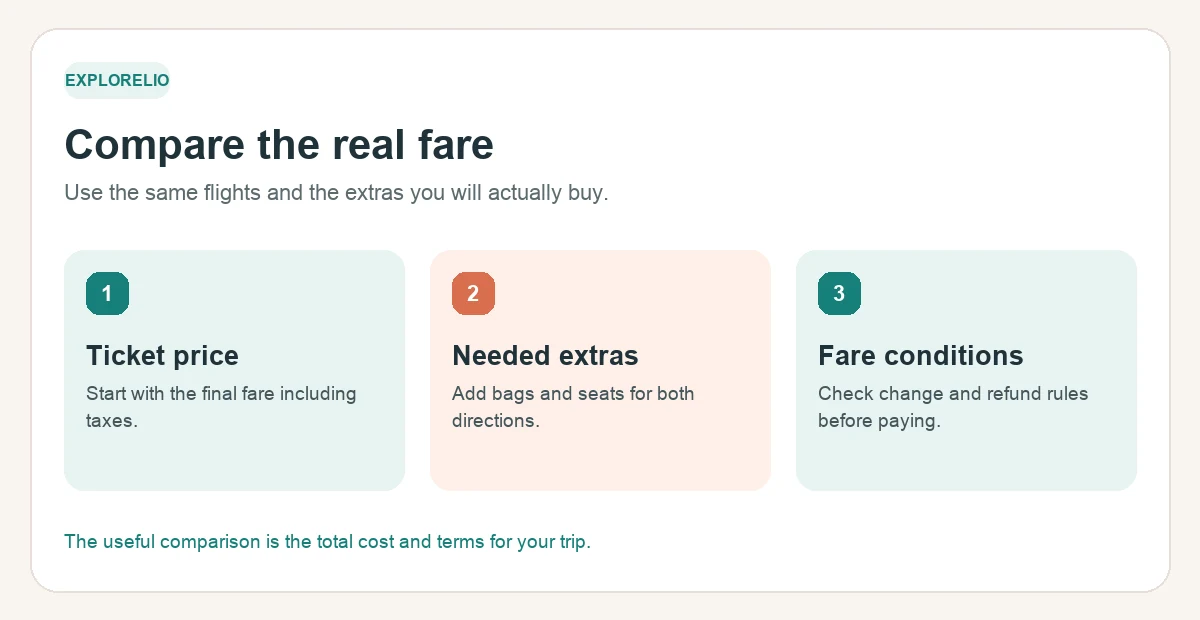
Measure your bag before comparing prices. A bag that fits beneath a seat is different from an overhead cabin case. If you need a checked bag, compare the cost of adding it to Light with the price difference to Standard. On a two-way itinerary, check whether the bag is included or purchased for both directions. Also check any connecting flight operated by a partner airline.
The Compare Airlines guide can help you look at the carriers themselves once you know which baggage question matters for your trip.

When is a higher fare worth it?
Think in terms of benefits you will use. Paying for Flex can make sense when dates may change, but it is less compelling if your leave dates are fixed and you only need a cabin bag. A middle fare can beat Light if it bundles a checked bag and seat choice for less than those add-ons cost separately.
For Economy Light vs Standard on the same flight, add only the extras you would buy. Here is a hypothetical example, not a current airline price: Light costs $150; a necessary checked bag costs $45 and the seat you want costs $15. Its relevant total is $210. Standard costs $195 with both included, so it is cheaper for that traveler. Someone who needs neither add-on still pays only $150 with Light. The same fare menu produces two different answers.
The seat question deserves a separate look. British Airways explains that seat selection conditions vary with ticket type; with a hand-baggage-only fare, a seat can be assigned at check-in unless you pay to choose earlier. If you are traveling together, compare the actual seat map and conditions shown during booking rather than treating seat selection as an automatic benefit.
Three trips, three different fare choices
A short weekend with a small bag. You know the dates, can travel with an underseat bag and do not mind the airline assigning a seat. In this situation, the lowest fare may be enough. Before choosing it, measure the bag you actually own and check whether the route allows it under the seat. A compact case with wheels can exceed an underseat limit even if it looks small in a photograph. If you discover you need an overhead cabin case, add that charge to both outbound and return flights before deciding that Light is cheaper.
A longer holiday with a checked suitcase. You will pay for a checked bag no matter which fare you buy. This is where an Economy Light vs Standard comparison often changes direction. The middle fare may bundle the bag more cheaply than the Light fare plus an add-on, but do the arithmetic separately for each direction. Some booking screens show a low price for the first leg while the return is a different fare or carrier. Record the included allowance for each leg; a single line saying “one bag” on a search result does not answer every transfer question.
A trip with uncertain dates. You may need to move your departure by a few days. The Flex price buys value only if its actual change or refund conditions solve that problem. Check the deadline, the method of refund and whether a new flight can cost more. Compare a realistic change scenario: the higher fare today versus the lower fare plus the relevant change fee and fare difference later. You cannot know the future fare difference, so treat the calculation as a range rather than a guaranteed saving.
There is one more detail when a booking contains several airlines: the fare label shown by a search site might describe only one carrier's product. Open the conditions for every operating airline and for the ticket as a whole. If the page offers different fare types on outbound and return, the best choice may be a Light outward leg and a Standard return leg. The point is to buy the benefits when you need them, not to pay for the same bundle twice out of habit. This Economy Light vs Standard check is especially useful when the bag allowance changes between legs.
A two-minute final-cost worksheet
Use this Economy Light vs Standard worksheet to compare one column for each fare on the same itinerary. Every amount should come from the live booking flow; leave an item as “not needed” when it truly does not apply.
| Cost or condition | Light | Standard | Flex |
|---|---|---|---|
| Ticket price with taxes | Enter checkout price | Enter checkout price | Enter checkout price |
| Required cabin or checked bag | Add actual fee or write “included” | Add actual fee or write “included” | Add actual fee or write “included” |
| Seat you would choose | Add actual fee or write “not needed” | Add actual fee or write “included” | Add actual fee or write “included” |
| Change or cancellation risk | Write the restriction you could accept | Write the restriction you could accept | Write the restriction you could accept |
| Final relevant cost | Ticket plus necessary extras | Ticket plus necessary extras | Ticket plus necessary extras |
Then check the details that a number cannot capture: whether you can make the trip if dates move, whether a refund returns to your original payment method, and whether the cabin bag you own actually meets the published size limit. Save a copy of the fare conditions before payment.
The practical answer
Choose Light when you genuinely travel light and can accept its restrictions. Choose Standard when its included bags or seats cost less than adding them to Light. Choose Flex when its precise change and refund terms are worth the extra price for your plans. No label wins on every route. An Economy Light vs Standard choice only makes sense after you price the bag and seat you actually need. Start with your real trip, then compare the final amount and the terms side by side.
Frequently asked questions
Does Economy Light always include a cabin bag?
No. The size and number of cabin items depend on the airline, route and fare. Check whether your bag is an underseat item or an overhead case before booking.
Is Standard cheaper than Light after adding a checked bag?
Sometimes. Add the bag charge for each direction to the Light fare, then compare it with the Standard price on the same flights. Do not rely on the fare name alone.
Does a Flex fare let me change flights for free?
Not necessarily. Flex may remove a change fee but still require a fare difference. Read the exact ticket conditions and deadlines.
Should I choose a fare based on the airline profile alone?
Use an airline profile to understand the carrier, then verify the specific fare conditions at checkout. Fare inclusions can differ even within the same airline.
Editorial method: We reviewed the airlines' current fare and seat guidance on 3 November 2026 and built a route-neutral cost checklist. The prices in the example are illustrative. The featured image is AI-generated editorial illustration, not a photograph of a specific airline.