

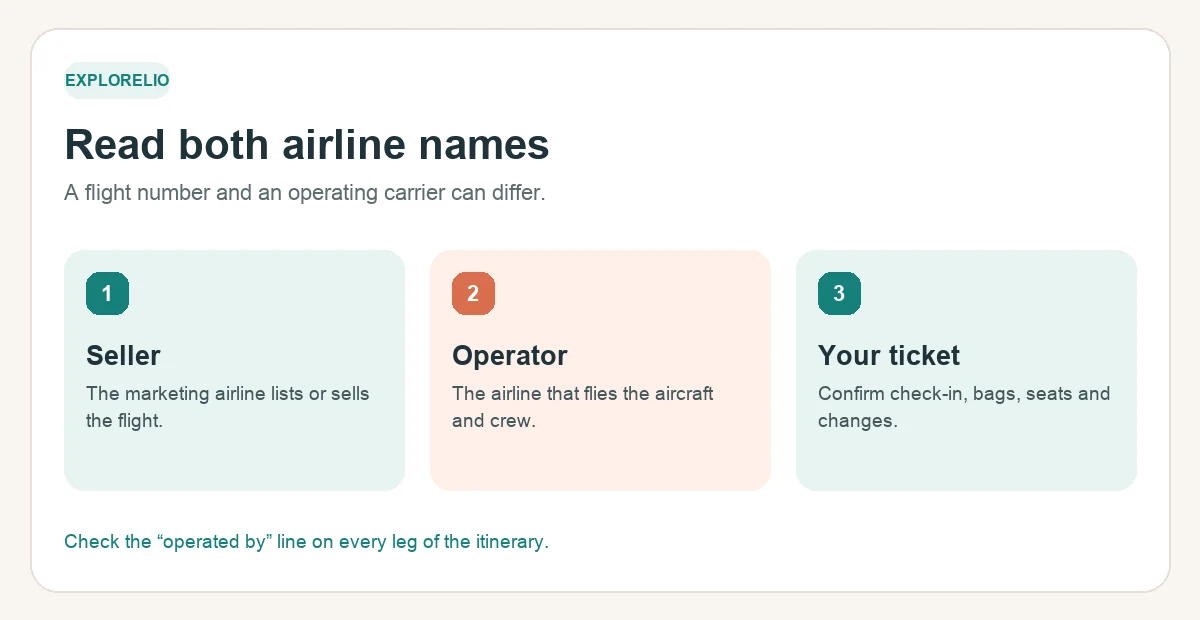
Codeshare flights can show one airline's flight number while the confirmation says “operated by” another. That is a codeshare: one airline markets the flight while a partner actually operates it. The distinction can affect the airport desk you visit, the aircraft you board and the service you receive. The ticket and partner agreement determine several other rules, so do not apply one airline's entire policy automatically.
The US Department of Transportation explains why the operating airline must be disclosed in a codeshare sale. Read that “operated by” line for every segment before choosing between itineraries.
Codeshare flights: marketing versus operating airline
The marketing airline sells or lists the flight under its code. The operating airline provides the aircraft and crew. American Airlines' partner guidance describes this distinction and notes that a partner flight can have different baggage or check-in procedures. One physical flight may therefore appear under more than one flight number in search results.
Suppose a search result has flight XY123 “operated by Airline Z.” The letters on the ticket identify the marketing flight number; Airline Z is the operator. This is a fictional example. In a real booking, open the flight details and record the actual airline name and flight number on each leg.
| Booking question | Start with | Then verify |
|---|---|---|
| Who flies the aircraft? | The “operated by” line | Aircraft and service details with that operator |
| Which desk handles check-in? | The operating carrier of the first flight | Instructions on the ticket and airline booking pages |
| Which cabin-bag rule applies? | Your ticket and operating carrier | Any partner or route exception before packing |
| What checked baggage is included? | Allowance printed on the booking | Rules for the complete itinerary, including transfers |
| Who handles a seat request? | Booking management link | Whether partner seat maps open through the operator |
| Who handles a voluntary change? | The ticket issuer or booking channel | Fare rules and partner procedure on your reservation |
This is a starting checklist, not a universal rulebook. Baggage and changes in particular can depend on the ticketing carrier, route, interline agreements and local rules. The confirmed allowance on your reservation is stronger evidence than a generic web page.
Where do you check in for codeshare flights?
In many partner itineraries, you check in with the airline that operates the first flight. American Airlines says partner check-in usually follows the first operating carrier. Still, read the instruction on your actual itinerary: airport arrangements, partner systems and exceptions can differ.
Check the operator's website or app using the partner reference supplied in your booking email. A marketing airline's booking code does not always work in a partner's system; you may need a separate record locator. If online check-in fails, confirm the airport desk before departure rather than assuming the flight number points to the right counter.
Bags and seats: the two details to inspect before paying
On codeshare flights, the airline selling the ticket and the airline flying the plane may display different general baggage pages. Your booking confirmation should state the baggage allowance for the ticket. Compare it with the operating carrier's size and weight limits for cabin baggage, and ask the seller if the itinerary has a mixed-carrier checked-bag rule. Do not infer the checked allowance from the operator's logo alone.
Seat selection can be equally awkward. A seat map may be unavailable on the marketing airline's site even when the partner lets you select a seat through its own booking page. Check whether the selected seat is confirmed on the operating flight. If you pay for a seat, keep the receipt and confirmation showing its flight segment.
When two search results are the same flight
An airline comparison page can show two results with different flight numbers and nearly identical times. Open both details before assuming you have found two separate services. If both say the same operating airline, departure time and route, the results may be two marketing versions of one physical flight. That does not mean the offers are identical tickets: the seller, fare conditions, bag allowance, change procedure or loyalty earning may still differ.
For codeshare flights like these, compare the final booking terms in two columns. Note the ticket issuer, operating carrier, cabin and exact fare name. Then add the bags and seats you will buy and read the change rules for each offer. If one site does not display the operator clearly, use the flight details page or ask before paying. A $20 price gap is not meaningful if the cheaper fare excludes a bag you need or makes a change difficult through a third-party seller. The dollar figure here is an illustrative comparison, not a live quote.
Also look at the whole journey. One result may combine the same codeshare flight with a different onward connection. The initial leg can be identical while the total trip time, arrival airport or ticket protection differs. This is why the “operated by” line belongs in your itinerary notes, not just in a small-print footnote.
After booking: keep both references
Save the e-ticket receipt, the marketing airline's reservation code and any separate code for the operating airline. Open the trip on the operator's site once you receive the confirmation. Confirm that names, dates, flights and any paid seats appear there; if the partner site does not recognize the booking immediately, contact the ticket issuer rather than making a second reservation.
If a partner booking reference is missing, ask the ticket issuer for the operating airline’s reference while there is still time to resolve an error. When the operator’s site displays the trip, compare the flight date, cabin and bag allowance with the original receipt. A codeshare can show the same physical flight under two numbers, so a different number alone is not a problem. A different date, cabin or allowance needs attention. Keep screenshots of the confirmed itinerary and the fare conditions, and use the ticket issuer’s contact route for a correction before the airport day.
Before departure, recheck the operating carrier and terminal on the airline's own pages. Schedules, aircraft and partner arrangements can change. If a flight is rebooked, confirm the new baggage allowance and any purchased seat on the replacement service. Keep the old and new confirmations so a customer-service agent can see what was originally bought.
The most useful habit with codeshare flights is simple: know who sold the ticket, who flies each leg and where you will check in. Those three facts tell you which question to ask next. They also keep a confusing search result from becoming an airport surprise.
For the airline side of the decision, our British Airways guide and KLM guide help you compare carrier services. Their general profiles are useful context; the exact codeshare ticket still decides the applicable inclusions.
A five-step check before you book
- Open the details of every flight leg and record the operating carrier.
- Confirm the ticket is one reservation if you expect bags to transfer and want a protected connection; a codeshare label alone does not establish this.
- Compare the total fare after the bags and seats you need, using the allowance shown on the actual booking.
- Check the marketing airline's fare rules and the operator's airport and onboard procedures.
- Save the final itinerary and partner booking reference. Recheck flight details before travel, because an operator or schedule can change.
If you are comparing codeshare flights alongside other carriers, continue with Explorelio's airline comparison hub. It gives you a place to compare airline guides before you inspect the live itinerary.
The practical answer
For codeshare flights, start with the operating airline for the aircraft, airport check-in and onboard experience. For bags, seats, changes and refunds, verify the rules printed on the specific ticket and the procedure supplied by the seller and operator. The most common mistake is treating the marketing airline's flight number as proof that it operates the service.
Frequently asked questions
Editorial method: We used airline partner guidance and US DOT codeshare disclosure guidance checked on 3 November 2026. The fictional XY123 example illustrates how to read a booking; it is not a real service. The featured image is AI-generated editorial illustration.