

Self-transfer vs connecting flight: the difference starts with the ticket. Two itineraries reach the same destination. One is sold as a connection on a single ticket; the other combines separate flights for less money. The second may be labelled self-transfer. It can be a good choice when you have enough time and can handle the extra steps, but the headline saving does not buy the same protection if the first flight is late.
The difference begins with the booking, not the number of airlines. A journey on two carriers can still be on one ticket. Conversely, two flights on the same airline can be separate reservations. Check the ticket numbers and booking terms before assuming a connection is protected.
Self-transfer vs connecting flight: what changes?
| Decision point | Single-ticket connection | Self-transfer on separate tickets |
|---|---|---|
| Delayed first flight | The carrier or ticketing partner normally handles a disrupted onward journey under the ticket terms | The second flight may treat a late arrival as a missed departure; you may need a new ticket |
| Checked baggage | It may be tagged to the final destination, subject to route and partner arrangements | You should expect to collect and recheck it unless both airlines explicitly confirm otherwise |
| Check-in | Usually managed as one itinerary, although partner check-in steps can vary | You may need a separate check-in and boarding pass for each ticket |
| Immigration and security | Follow the airport's transit route and entry requirements | You may need to enter the country to reclaim bags and check in again |
| Time margin | Compare the published connection and any terminal change | Allow enough time for baggage, immigration, check-in deadlines and unexpected delay |
| Total cost | Use the final fare and included bags | Add bags, ground transfers, possible overnight stay and a risk buffer |
The self-transfer vs connecting flight distinction matters most when the first aircraft is late. “Normally” does not mean guaranteed. A single ticket's remedies depend on the airline's terms and applicable passenger-rights rules. Also, airport and nationality can change the immigration process. Heathrow's connecting-flights guide is a useful example of why separate-ticket travelers must inspect the airport-specific transfer steps.
The hidden time in a self-transfer
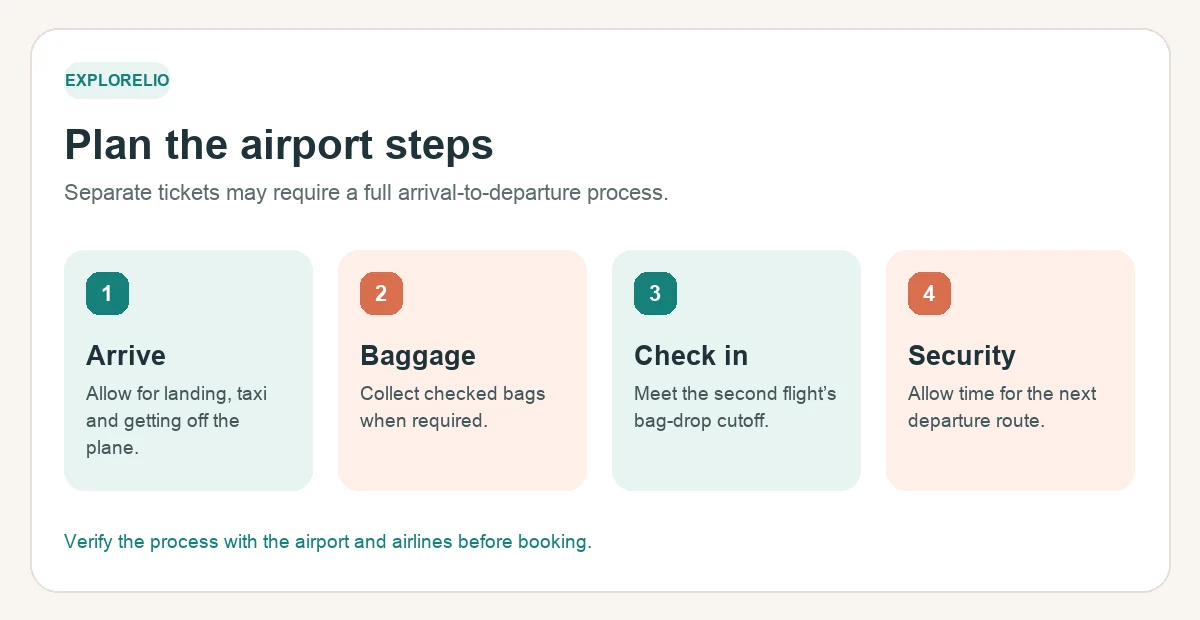
Search results often show only the gap between scheduled arrival and departure. That gap is not all usable transfer time. Your first aircraft must reach a gate; if you checked a bag, it has to arrive on the belt; you may need to clear immigration, change terminals, recheck your bag and pass security. The next airline's check-in or bag-drop deadline may be well before departure.
Use this sequence to estimate the time you need, not a universal “safe” connection time:
- Check the arrival terminal and scheduled landing time of the first flight.
- Find the baggage-delivery, immigration and terminal-transfer process on the airport's official site.
- Find the second airline's check-in and bag-drop cutoffs for the route.
- Add a realistic delay margin for the first flight and for queues. If an overnight stay is possible, include its cost.
- Check whether you need permission to enter the transit country. An airside transit exemption may not help if you must leave the secure area to collect a bag.
For self-transfer vs connecting flight planning, there is no single buffer that works for every airport, itinerary or traveler. A short transfer that is feasible with hand baggage and online check-in might fail with a checked bag or a terminal change.
Three connection situations to test
Same terminal, hand baggage only. You already have the second boarding pass and can remain within the airport's permitted transfer route. This can reduce the steps, but it does not turn separate tickets into a protected connection. Confirm that the airport allows that airside path and that you meet every transit-document requirement. If a delay on the first flight would still leave you only a few minutes before boarding closes, the saving may not justify the exposure.
Checked bag or terminal change. Assume you will need to reach baggage reclaim, collect the suitcase and present it at another airline's desk. Check whether the terminals are connected by a free shuttle, a paid train or a transfer that involves another security checkpoint. Even at the same airport, the time between landing and the second bag-drop deadline can be much shorter than the search result suggests. An online boarding pass does not waive a checked-bag cutoff. This self-transfer vs connecting flight choice becomes particularly important when the onward flight is the day's last service.
Overnight stop. A separate-ticket itinerary with a night between flights may be more workable than a tight same-day connection. You have time to reclaim bags and return for the next departure. Include the hotel, airport transfer and meals in the comparison, and check whether you are allowed to enter the country for the night. An overnight buffer reduces some timing risk, but it is not a guarantee: a cancelled first flight can still disrupt the second ticket. The rest of your trip may be affected if the replacement flight arrives a day late.
For all three scenarios, write down a fallback before paying. If the first flight is delayed, is there another onward flight you could buy, and at what approximate price range? Could you stay overnight? Does your travel insurance explicitly cover missed connections on separate tickets? Read the policy language rather than assuming every delay qualifies. You do not need to predict a precise disruption; you need to know whether its possible cost would erase the apparent saving.
This self-transfer vs connecting flight test often changes a decision even when the separate tickets are much cheaper. It places the cheap fare in the context of the trip you actually need to complete.
Compare the real price, not two search-result numbers
For a self-transfer vs connecting flight price comparison, count every step you will pay for. Imagine, only as an example, a single-ticket connection for $420 and two separate tickets for $330. The apparent saving is $90. If the second ticket requires a $35 bag fee and a $25 transfer between airports, the saving falls to $30 before considering the risk of buying a replacement flight. That does not automatically make the separate tickets wrong; it makes the decision more honest.
| Cost to include | What to enter for a real trip |
|---|---|
| Flight tickets | Final price including taxes for both options |
| Bags | All required cabin and checked-bag charges on each ticket |
| Airport transfer | Terminal transfer or travel between separate airports |
| Accommodation | Hotel cost if a prudent transfer needs an overnight stay |
| Missed-flight exposure | Refund and rebooking conditions of the second ticket |
| Time | Hours of your trip lost to the longer route or transfer |
When you compare airlines on the same route, use Explorelio's Compare Airlines hub to understand the carriers, then inspect the exact fare and ticket structure. The hub cannot tell you whether two flights in a search result are on one protected booking; the checkout details can.
What about passenger rights?
Rules depend on where you fly, the airlines involved and how the itinerary is booked. The European Union's passenger-rights guidance treats missed connections under the conditions stated there, including the requirement that relevant flights be booked as a single reservation for certain compensation claims. Do not assume separate tickets give you the same missed-connection remedy. Read the specific rule for your journey and keep both confirmations.
If the flights are advertised as one booking but the checkout warns “self-transfer,” open the details. Some sites bundle separate tickets in one transaction. A single payment screen alone is not proof of a single ticket.
The practical answer
In a self-transfer vs connecting flight decision, choose the single-ticket connection when a missed onward flight would be expensive or disruptive, your connection is tight, or you have checked baggage and complex transit. Consider a self-transfer when the total saving is meaningful, you have a generous buffer and you understand the airport and entry steps. In either case, confirm the ticket structure before paying.
Frequently asked questions
Does one booking confirmation mean my connection is protected?
Not always. Some booking sites sell separate tickets in one transaction. Look for the self-transfer warning, ticket numbers and conditions for each flight.
Do I have to collect my bag on a self-transfer?
Plan to collect and recheck it unless the airlines explicitly confirm through-checking for your exact itinerary. Verify the destination printed on the bag tag at the airport.
Can I stay airside on separate tickets?
Sometimes, if you have no checked bag, a valid onward boarding pass and the airport permits that transfer. Check the airport's official rules, terminal layout and any transit or entry requirements for your nationality.
Will the second airline rebook me if the first flight is late?
Do not count on it for separate tickets. Check the second fare's missed-flight and change terms, as well as any protection explicitly offered by the seller.
Editorial method: We reviewed Heathrow transfer guidance and EU passenger-rights guidance on 3 November 2026. The dollar example is hypothetical and does not quote live fares. The featured image is AI-generated editorial illustration.